NEWS & ANNOUNCEMENT
TOWN HALL SCHEDULED FOR MAY 17th
OUR COMMUNITIES DESERVE ANSWERS ABOUT TOXIC LANDFILL & RELATED CANCER CASES IN KEYPORT & UNION BEACH
A growing number of families in Keyport and Union Beach are asking urgent questions about the former Aeromarine landfill site. State officials are now investigating whether contamination may have spread beyond the landfill into nearby neighborhoods.
“Residents are urgently seeking answers.”
— NJDEP / NJDOH
“The landfill has never been fully remediated.”
— Congressman Frank Pallone
“More than 40 cancer cases, including 28 on one street.”
— Congressman Frank Pallone
“The property owners (of Aeromarine) have not taken substantive redevelopment or comprehensive remediation to date.”
— Congressman Frank Pallone
NOW IS THE TIME FOR OUR COMMUNITY TO COME TOGETHER.
JOIN US FOR A COMMUNITY TOWN HALL
Residents • Families • Health Advocates • Environmental Experts • Public Officials
DATE:
Sunday, May 17
TIME:
4:30 PM – 6:30 PM
LOCATION: (To be announced)
Topics Include:
• Environmental contamination
• Health and cancer concerns
• NJDEP investigation updates
• Community impact
• Next steps for residents
• Accountability and remediation
All residents of Keyport, Union Beach, and the surrounding Bayshore communities are encouraged to attend.
Protect Our Families. Protect Our Future. Demand Answers.
Website: KeyportUNITED.org & UnionBeachUNITED.org
Facebook: Keyport UNITED & Union Beach UNITED
How Did It Start?
Before Aeromarine: Keyport as a working waterfront
Before anyone called this an environmental problem, Keyport was a working waterfront town. Its shoreline, creeks, marshes, boatyards, industrial yards, shellfish beds, rail spurs, docks, and fill areas all became part of the story. Pollution in Keyport should not be treated as one single event or one single villain. A better frame is that Keyport grew during an era when waterfront land was often treated as useful, expendable, fillable, and industrial. Marshes were filled. Shoreline edges were hardened. Wastes were pushed toward the water. What looks today like a single “site” was once part of a larger pattern of industrial waterfront behavior.
1908-1914: The aviation story begins
The roots of Aeromarine go back to Inglis M. Uppercu's involvement with early aviation experiments in Keyport. The Keyport Historical Society states that the Aeromarine Plane and Motor Company operated in Keyport from 1914 to 1930, and that its beginnings dated to 1908, when Uppercu began financing aeronautical experiments by a small Keyport firm. This matters because the site did not begin only as a dump. It began as an aviation and industrial landscape. First came manufacture, machinery, engines, aircraft, seaplanes, fuel, coatings, metals, solvents, shops, sheds, rail/water access, and industrial handling. The landfill came later.
1917-1920s: World War I production and industrial expansion
Work on the Aeromarine site accelerated around World War I, when military aircraft and seaplane production expanded. Surviving descriptions identify specialized shops and industrial functions. This makes the site historically important and environmentally relevant: aviation and engine manufacturing in that era commonly involved fuels, oils, paints, varnishes, metals, plating chemicals, degreasers, solvents, and waste residues. Do not state that all specific chemicals were dumped unless records prove it. The safer legal wording is that those are plausible categories investigators should seek in records and sampling data.
1924-1930s: Corporate decline, successor activity, & lingering industrial use
Some sources indicate the original Aeromarine Plane and Motor Company was out of business by the mid-1920s, while Aeromarine-related companies continued to use the facilities into the late 1920s or around 1930. The Keyport Historical Society notes that from 1928 to 1930 the company was known as Aeromarine-Klemm Corporation. A serious chronology should separate “Aeromarine” as company, factory complex, airfield, industrial park, and later landfill.
Late 1930s: The airfield era ends
The adjacent Aeromarine airfield was reportedly last used in the late 1930s. After that, the land's identity shifted away from aviation and toward industrial, storage, fill, and landfill uses. The pollution story likely changes character here, from manufacturing waste alone toward landfill waste, uncontrolled dumping, poor capping, groundwater movement, shoreline migration, methane, and contamination reaching Chingarora Creek and Raritan Bay
1940s-1950s: The undocumented danger zone
This is one of the most important periods to investigate. Many New Jersey waterfront and marsh areas were filled before modern environmental regulations. Public sources do not yet provide a clean year-by-year record for dumping in Keyport during the 1940s and 1950s. This is exactly the period where oral histories, tax records, aerial photographs, Sanborn maps, borough minutes, deeds, and DEP predecessor-agency files may reveal what was dumped, where, and by whom.
1962-1979: Aeromarine becomes an active landfill
Recent public statements and reporting describe the former Aeromarine property as a roughly 50-acre site that became a dumping ground or landfill around 1962 and continued until it was shut down in 1979. This is the central operating period for the modern environmental case. If the landfill operated from 1962 to 1979, it operated before current expectations for engineered caps, liners, leachate controls, methane controls, groundwater monitoring, and formal closure plans were fully mature.
June 1977: Early municipal threat of legal action over landfill operations
A newspaper article titled “Keyport ready to sue on landfill,” by Lee Duigon, reports that Mayor William Ralph threatened to go to court unless state authorities met with the Borough Council about a 14-acre landfill operated by Waste Disposal Inc. The borough claimed the landfill was exceeding the 25-foot limit for which it had been licensed. Ralph reportedly said he would seek a restraining order to halt operation unless the state listened to the borough's objections. The article also reported allegations of inadequate daily cover, odor, leaching into soil, and pollution spreading toward Chingarora Creek and Keyport Harbor. This is not proof that a lawsuit was actually filed, but it is important evidence that local officials had identified landfill problems and were threatening legal action before the 1979 shutdown
1979: DEP shutdown
In 1979, New Jersey DEP ordered the Aeromarine landfill shut down. Congressman Pallone's 2026 letter states that DEP cited “numerous operating and engineering deficiencies and overall exhaustion of capacity.” Closure is not the same as cleanup. The continuing issue is whether the landfill was ever properly capped, fully closed, secured, monitored, or remediated.
1986-forward: State inspections and repeated violations
Pallone's April 17, 2026 letter states that state inspections dating back to 1986 repeatedly identified environmental violations, often with extended intervals between inspections during which conditions further deteriorated. This is a major addition because it helps fill the apparent post-1979 regulatory gap. The actual inspection reports should be obtained because they may establish notice, repeated noncompliance, and failure to act.
1989: Master Plan recognizes landfill/environmental constraints
Keyport planning records later summarized the 1989 Master Plan as calling for the Aeromarine property to be rezoned as a planned district, with residential development, open space/recreation, traffic/circulation planning, and submission of an environmental impact statement addressing the landfill. The same summarized objectives noted that density should be restricted due to environmental conditions and that future waterfront access should be preserved.
1990s: Ownership and post-closure property history require tighter proof
The chronology currently names Bushwick Realty Corp. and Bay Ridge Realty Corp. in connection with later property identity and enforcement. This section should be treated as incomplete until deed research is finished. For legal use, the chain of title should show who owned the property during landfill operation, who owned it after closure, who received notices, and who had responsibility for closure/capping/remediation.
2001: Reexamination Report recommends redevelopment study
Keyport's Aeromarine Redevelopment Plan later states that the 2001 Reexamination Report recommended that the Aeromarine area be studied to determine whether it was an area in need of redevelopment under New Jersey redevelopment law. This is important because environmental conditions were not treated as isolated complaints; they were embedded in formal land-use planning.
2005: Aeromarine Area Redevelopment Plan requires remediation and waterfront access
The 2005 Aeromarine Area Redevelopment Plan required deleterious environmental conditions on the site to be remediated and required public access along the Raritan Bay and Chingarora Creek waterfronts. It also required substantial open space and contemplated recreational use, including the possibility that capped landfill could be used for active or passive recreation. The plan shows that cleanup, redevelopment, and public access were linked municipal goals.
2010: Solar overlay amendment recognizes landfill cleanup cost as a barrier
The 2010 Solar Overlay Amendment allowed an alternate redevelopment path: a ground-based solar energy facility on the landfill portion of the site. Keyport's Strategic Recovery Planning Report later explained that this reflected the challenge that landfill cleanup might be cost-prohibitive for residential or recreational uses. This is important because it shows the landfill condition continued to shape land-use options decades after closure
2010-2011: Environmental investigation documents serious landfill conditions
Pallone's 2026 letter states that a 2010 environmental assessment documented serious deficiencies in the landfill's condition and that later legal filings referenced lack of adequate engineering controls, migration of solid waste beyond site boundaries, hazardous substances including heavy metals, methane, benzene and PCBs, and contamination of soil, groundwater, Chingarora Creek and Raritan Bay. Keyport's Municipal Public Access Plan states that the landfill portion of the Aeromarine site was subject to a Site Investigation and Remedial Investigation Report in January 2011; although the report was found to comply with DEP remediation requirements, the existing landfill cap needed improvement.
2012-2015: Public access plan identifies Aeromarine as restricted and environmentally constrained
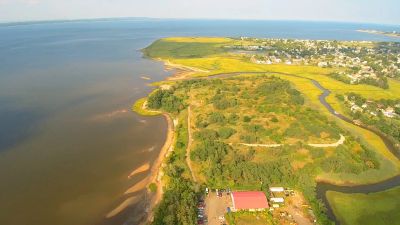
Keyport's Municipal Public Access Plan describes the Aeromarine Site as a complex of industrial buildings and about 40 acres of extensive landfill adjacent to wetlands, Chingarora Creek and Raritan Bay. The plan states that public access to the waterfront along the site was prohibited because of public health and safety concerns associated with the landfill and possible environmental damage to wetlands, while beach access from Walnut Street was still possible. The plan also states that the Borough sought to complete remedial actions and enforce public-access easements in future redevelopment.
2013: Strategic Recovery Planning Report ties Aeromarine cleanup to post-Sandy recovery and land-use resilience
Keyport's 2013 Strategic Recovery Planning Report identified cleaning up and creating viable use of the Aeromarine site as part of the Borough's planning concerns. It described the 2005 redevelopment plan, the 2010 solar overlay amendment, and noted that during Superstorm Sandy surge the site essentially became an island, with the elevated landfill portion among the only areas not flooded. This may be relevant to climate, flood, shoreline, contaminant migration, and redevelopment arguments.
2021: Keyport lawsuit against Bay Ridge Realty
Pallone's 2026 letter states that findings from the 2010 environmental assessment were later referenced in a 2021 lawsuit filed by the Borough of Keyport. As summarized by Pallone, the lawsuit referenced substantial portions of the landfill adjacent to Raritan Bay, lack of adequate engineering controls, migration of solid waste beyond the site boundary, migration of hazardous substances into soil and groundwater, and contaminants reaching Chingarora Creek. This should be supplemented with the actual complaint, docket, exhibits, orders, settlement documents, and current status
2021: First DEP monetary penalty
Pallone's April 17, 2026 letter states that the first DEP monetary penalty occurred in 2021 in the amount of $15,000. This belongs in the chronology because it shows formal state enforcement after decades of concerns. The underlying notice of violation, administrative order, or penalty assessment should be obtained.
2024: Suspected lead or hazardous material found near beach
Pallone's letter states that after reports of suspected lead on the beach near the former Aeromarine landfill in 2024, he coordinated a response with DEP and EPA to investigate, test, and clean up hazardous material from the beach. News 12 later reported that chunks of lead and arsenic had washed up two summers earlier and that signage still warned beachgoers not to touch such material if they saw it.
2024-2025: DEP penalties approach $900,000 and remain unpaid
Pallone's letter and press release state that DEP issued additional penalties of approximately $300,000 in 2024, which increased to nearly $900,000 in 2025, and that the penalties remained unpaid as of April 2026. Recent reporting also described the owner as facing nearly $900,000 in DEP fines. For lawsuit readiness, obtain the actual DEP penalty documents, administrative orders, and proof of nonpayment
April 2026: Cancer concerns become a public crisis
In April 2026, the issue moved into a new phase after residents raised concerns about a possible cancer cluster near First Street. Pallone's office stated that more than 40 cancer cases had been identified, including 28 clustered on or around First Street near the landfill. Reporting by News 12 and CentralJersey.com repeated the 41-case/28-on-First-Street figures and emphasized that no official causal link had yet been established. This distinction is important: community-reported cancer cases are alarming, but they are not the same as a confirmed cancer cluster or proven causation.
April 17, 2026: Pallone demands state-federal action
On April 17, 2026, Congressman Frank Pallone publicly requested coordinated action by NJDEP, the New Jersey Department of Health, ATSDR, and EPA Region 2. He requested site security, comprehensive testing of soil/groundwater/sediment/air, assessment of contaminant migration, cancer data review, mitigation planning including methane and contaminant leaching, enforcement of penalties and legal remedies, and transparent communication with residents.
April 21-23, 2026: State and local public response intensifies
News 12 reported on April 21, 2026 that Keyport officials were demanding answers, that a 2010 DEP study found toxins leaking from the former Aeromarine landfill into Raritan Bay, and that officials said nothing had been done to cap it. CentralJersey.com reported on April 23, 2026 that New Jersey health officials confirmed they were investigating a potential cancer cluster and that State Health Commissioner Raynard Washington said the state would move through the process while cautioning that connecting cancer diagnoses to a shared environmental cause is complex.
2026: Advocacy pressure and cleanup demands
The Sierra Club's 2026 action page demanded that Keyport and state officials hold Bay Ridge Realty accountable, clean up Aeromarine, remove exposed slag and hazardous debris, provide a public forum, install signage, set a firm remediation deadline, and, if the owner fails to act, have the state step in and place a lien for cleanup costs. This is advocacy material, not a neutral government finding, but it is useful for showing public pressure and community demands.
2026: Potential sale/redevelopment interest
Recent reporting and public statements indicate that a potential buyer or redevelopment partner may be involved, which could affect cleanup timing, financing, ownership, and liability strategy. For legal use, this area needs careful verification through council minutes, contracts, redevelopment agreements, purchase agreements, escrow documents, and DEP correspondence. Do not rely on press statements alone.
Late April–May 2026: Ongoing developments and current status
As of late April and early May 2026, the situation remains active and unresolved, with multiple parallel tracks underway. State health officials have formally begun investigating the reported cancer cases, though they continue to emphasize that identifying a causal environmental link is a complex, multi-step process that may take significant time. At the same time, pressure is increasing on regulatory agencies to accelerate environmental testing, site security, and public communication. Congressman Frank Pallone’s call for coordinated federal and state intervention has elevated the issue beyond the local level, and agencies including NJDEP, NJDOH, EPA Region 2, and ATSDR are now under heightened scrutiny to respond.
Public concern remains high, particularly following reports of hazardous materials washing onto nearby beaches and longstanding questions about the integrity of the landfill cap and containment systems. Advocacy groups and residents are continuing to push for immediate remediation, stricter enforcement of existing penalties, and clearer accountability for responsible parties. Discussions of potential redevelopment or sale of the site are also ongoing, though these remain uncertain and dependent on environmental liability, cleanup requirements, and regulatory approvals.
In short, the Aeromarine site has entered a new phase defined by active investigation, increased political and public pressure, and the possibility—though not yet certainty—of more aggressive enforcement or intervention. The key unanswered questions now center on the extent of contamination, the validity of potential health impacts, and who will ultimately bear responsibility for remediation and long-term monitoring.
Chronology (5-4-26) prepared by John R. Schneider